

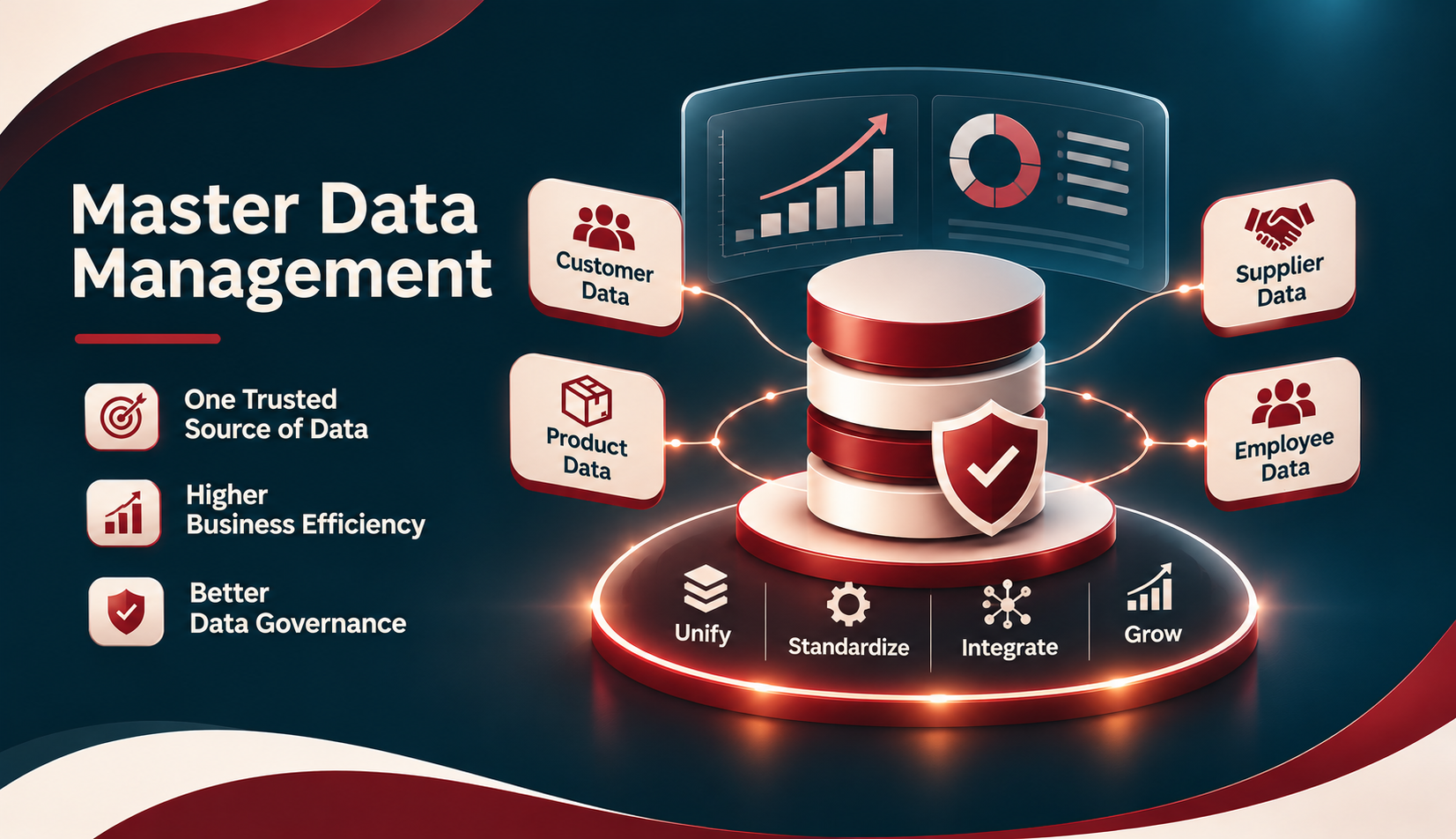
Data plays an important role in every business. Companies use customer details, product information, supplier records, and employee data to manage daily operations. However, keeping this information accurate across different systems can be difficult.For example, a company may store the same customer’s details in its CRM, billing software, and sales application. If the information is updated in only one system, other departments may continue using outdated records.This can lead to duplicate information, errors, and poor business decisions.
Master Data Management (MDM) helps businesses solve this problem by creating a consistent and trusted view of important business information.
In this guide, we will explore what MDM is, how it works, its benefits, and how DatAInfa helps organizations manage their business data.
What Is Master Data Management (MDM)?
Master Data Management is the process of collecting, organizing, and maintaining accurate business information across different systems.
Master data includes important business information such as:
1. Customer Data: Names, contact details, addresses, and customer IDs.
2. Product Data: Product names, descriptions, prices, and specifications.
3. Supplier Data: Vendor details, addresses, and payment information.
4. Employee Data: Employee records, job roles, and departments.
5. Location Data: Office addresses, warehouses, and business locations.
MDM helps organizations remove duplicate records, correct errors, and maintain consistent information across departments.
One important concept in MDM is the Single Source of Truth. It means having one trusted version of important business information.
For example, if three systems contain different records for the same customer, MDM helps identify and combine the most reliable information into a single master record, commonly called a Golden Record.
Why Is Master Data Management Important?
Businesses need accurate information to manage operations and make better decisions. MDM offers several important benefits.
- Better data accuracy: MDM helps identify incorrect, outdated, and duplicate records, making business information more reliable.
- Improved decision-making: Consistent information helps management teams prepare better reports and make informed business decisions.
- Better customer experience: Customer Master Data Management creates a unified customer profile, helping sales and support teams access accurate information.
- Reduced operational work: Businesses can reduce repeated manual updates and spend less time correcting data errors.
- Stronger data governance: Master Data Governance establishes clear rules for data ownership, access, updates, and approvals.
Businesses can explore DatAInfa’s Data Governance and Privacy services to understand how structured governance supports better data management.
How Does Master Data Management Work?
MDM follows a structured process to manage business information.
- Data collection: Information is collected from different systems, including CRM, ERP, databases, and business applications.
- Data cleansing: Incorrect, incomplete, and outdated records are identified and corrected.
- Data matching: Duplicate records belonging to the same customer, product, or supplier are identified.
- Golden record creation: The most reliable information is combined into one trusted master record.
- Data distribution: Approved information is shared with connected business applications.
These activities help organizations maintain consistent information across their systems.
What Are the Different Types of Master Data Management?
Businesses manage different types of master data depending on their operations.
Customer Master Data Management: Focuses on maintaining accurate customer names, contact details, addresses, and account information across business applications.
Product Master Data Management: Helps businesses organize product names, descriptions, categories, prices, and specifications. It is especially useful for retail, e-commerce, and manufacturing companies.
Supplier Master Data Management: Maintains accurate vendor details, payment information, contact records, and procurement data.
These data domains form an important part of an effective Enterprise Data Management strategy.
How Does DatAInfa Support Master Data Management?
Managing master data requires the right combination of technology, data quality, integration, and governance.
DatAInfa Solutions helps organizations manage, integrate, and improve business information through its Enterprise Data Management services.
Its approach can include:
- Understanding existing data sources and business requirements.
- Identifying duplicate and inconsistent records.
- Improving data quality and standardization.
- Integrating information from different applications.
- Supporting data matching and validation.
- Providing implementation, management, and ongoing support.
DatAInfa also offers Data Quality and Observability services to help organizations identify data errors, monitor data health, and maintain reliable information.
For businesses looking for MDM Solutions, DatAInfa works with enterprise data platforms and technologies, including Informatica. Explore DatAInfa’s Informatica and MDM capabilities.
Real-World Master Data Management Examples
MDM is useful across industries because every business depends on accurate information.
DatAInfa has published several relevant project examples:
Oil and Gas: DatAInfa reports a 40% improvement in data accuracy through an MDM project that helped recover a stalled implementation. Read the oil and gas MDM case study.
Pharmaceuticals: An MDM project focused on connecting supplier and product information to create a more trusted supply chain foundation. Read the pharmaceutical case study.
Retail: A centralized Product 360 and MDM foundation brought product information from more than 125 brands into one trusted source. Read the retail case study.
These examples show how businesses can use MDM to address different data management challenges.
What Are the Common Challenges of MDM?
Although MDM offers many benefits, implementation can involve some challenges.
- Poor data quality: Existing records may contain errors or duplicate information.
- System integration: Connecting different applications and databases can be complex.
- Data ownership: Departments may have different responsibilities for maintaining information.
- Implementation costs: Software, infrastructure, and integration require investment.
- Employee adoption: Teams may need training to follow new data management processes.
A clear implementation plan, suitable technology, and strong data governance can help businesses manage these challenges.
How Is AI Changing Master Data Management?
Artificial Intelligence (AI) is making data management more efficient.
AI-powered tools can help identify duplicate records, detect unusual data patterns, classify information, and suggest corrections.
For example, AI can identify customer records that contain slightly different names but may belong to the same person.
As businesses adopt AI and advanced analytics, accurate and reliable master data becomes even more important.
FAQ
The main purpose of MDM is to maintain accurate and consistent business information across different systems. It helps reduce duplicate records and improve data quality.
MDM focuses on managing consistent master records, while Master Data Governance defines the rules, responsibilities, and policies for maintaining that information.
Popular platforms include Informatica MDM, IBM Master Data Management, SAP Master Data Governance, Oracle MDM, and Reltio.
Yes. Small businesses can use MDM practices to manage customer, product, and supplier information more effectively.
MDM improves the quality and consistency of business information, providing more reliable data for AI applications, machine learning, and business analytics.
Conclusion
Master Data Management helps businesses maintain accurate, consistent, and reliable information across different systems. It reduces duplicate records, improves data quality, and supports better business decisions.
As organizations continue to adopt digital technologies, having a strong Enterprise Data Management strategy becomes increasingly important.
DatAInfa Solutions helps businesses explore MDM, data quality, integration, and governance solutions to improve how they manage business information.
Looking to improve your organization’s Master Data Management strategy?
Visit DatAInfa to explore its services or connect with the DatAInfa team to discuss your business data requirements.
Better Data. Better Decisions. Better Business Growt
